You don't have to love science like we do to benefit from Care222 systems, but we want to share some of the science behind our technology. The best way to do this is to talk about UV light, wavelengths, and the filter that makes our light so extraordinary.
Care222 krypton excimer lamps produce something called 222 nm Far UV-C light. These lamps contain a chamber filled with the noble gas krypton that uses no internal electrodes or mercury. When a high voltage is applied to the outside of the glass, it "excites" the gas inside, causing 222 nm Far UV-C light to be emitted.
The most significant difference between our 222 nm light and standard 254 nm light is the wavelength.
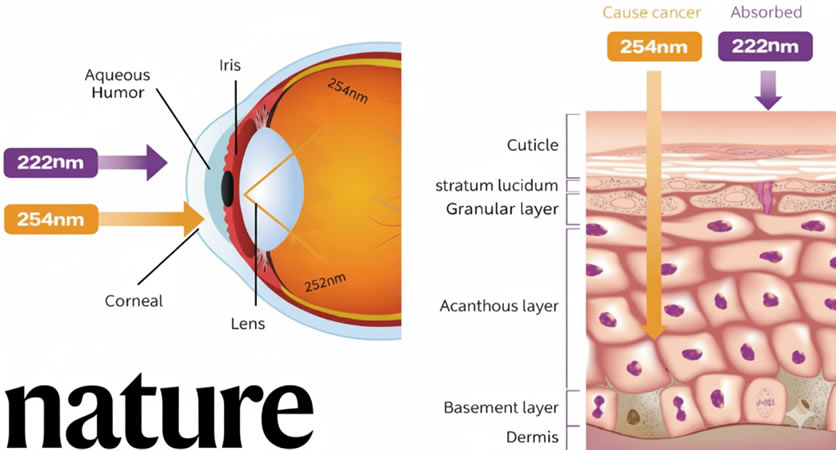
The shorter wavelength of UV-C light, 222 nm, has limited ability to penetrate beyond the outer layer of the skin. This layer, the stratum corneum, is composed of dead skin cells and serves as the primary barrier between the body and the environment.
On the other hand, longer wavelengths, such as 254 nm, can penetrate the skin layers and cause burns, skin cancer, and DNA damage in skin cells. The real breakthrough in our technology came with the development of a new type of light filtration system. Our filtered Far UV-C krypton excimer lamp module prevents the emission of longer wavelengths of UV light, above 230 nm—a particularly important feature that other 222 nm and Far UV-C emitting products lack. This is why the unique Care222 module is the superior choice compared to the lamps without filters used in disinfection systems.
USHIO's Care222® filtered Far UV-C technology is protected by patents in the U.S. and other countries covering devices and methods for inactivating pathogenic microorganisms with combinations of a light source and an optical filter that blocks potentially harmful UV-C wavelengths. The inventions in these patents are credited to Dr. David Brenner et al. and assigned to Columbia University. USHIO Inc. is the exclusive worldwide licensee of these patents.
Scientific Reports in Nature:
In contrast, far-UVC light (207 to 222 nm) has been shown to be as effective as conventional germicidal UV light in killing microorganisms, but at the same time, it is suggested that these wavelengths do not cause the human health problems associated with direct exposure to conventional germicidal UV light. In short, far-UVC light has a range in biological materials of less than a few micrometers and therefore cannot reach living human cells in the skin or eyes, being absorbed in the stratum corneum of the skin or the tear layer of the eye.
222 nm UV-C light reduces germs without penetrating the skin or eyes.
While longer wavelengths, such as 254 nm, can penetrate the skin and cause burns and damage to cellular DNA, the shorter wavelength of 222 nm UV-C light does not penetrate beyond the outer layer of the skin. This layer, the stratum corneum, consists of dead skin cells and serves as the main barrier between our bodies and the environment. The outermost part of the eye, known as the tear layer, works similarly, preventing the 222 nm wavelength from penetrating the cornea.
222 nm UV-C light reduces the frequency with which we use chemicals.
Because 222 nm UV-C light can be used in the presence of people, it continuously eliminates pathogens in the air and on surfaces where it shines. This reduces the frequency with which chemicals are used throughout the day to keep shared spaces disinfected.
FAR UV-C light even reduces the spread of airborne viruses and bacteria.
FAR UV-C light, unlike traditional UV-C light, more effectively reduces airborne viruses and bacteria without requiring evacuation. Even when people are present, FAR UV-C light consistently reduces germs in the air and on surfaces, offering a safe and efficient solution for a more decontaminated environment. Our technology eliminates COVID-19, influenza, norovirus, and other threats to human health safely, quickly, and efficiently, eliminating them wherever the FAR UV-C light shines. The action of filtered FAR UV-C light inoculates spores, bacteria, viruses, fungi, yeast, and protozoa.
UV Germicidal: Introduction and History
Invisible Colors: The discovery of ultraviolet light
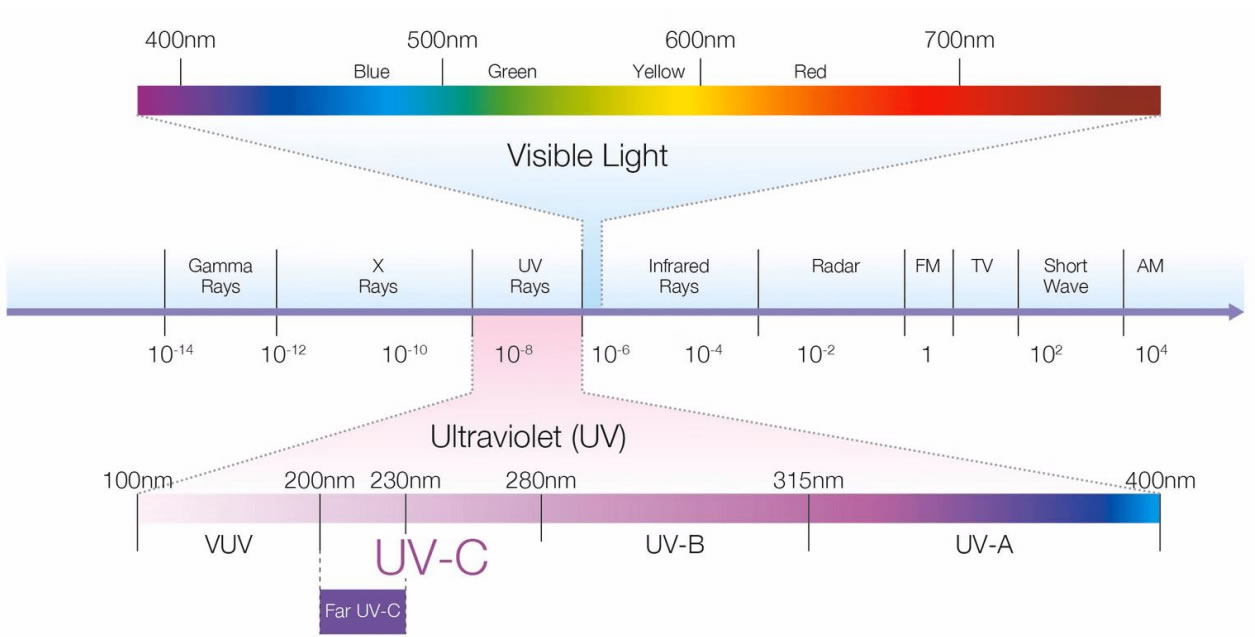
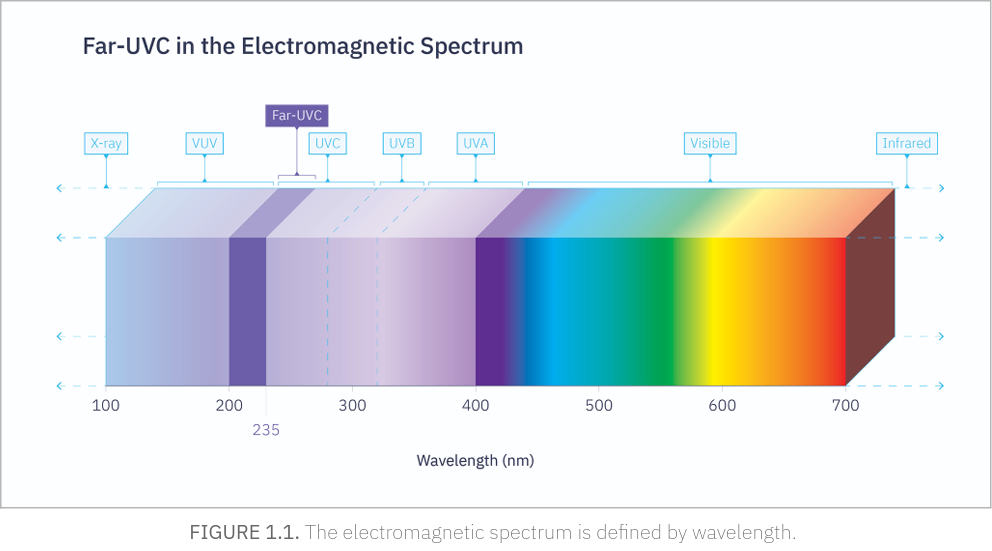
(UV) dates back to the early 19th century, when Johann Wilhelm Ritter first detected an invisible form of radiation beyond the violet end of the visible spectrum in 1801. He observed that this radiation caused silver chloride-coated paper to darken faster than visible light, indicating a high-energy, chemically reactive form of light, which he initially called "deoxidizing rays" before the term "ultraviolet" was later adopted. Like visible light, UV contains different "colors," and while invisible to the human eye, these different colors are as distinct as red and blue (Figure 1.1). What we know as "black lights," widely used for everything from electrocuting mosquitoes to lighting nightclubs, are actually part of a set of invisible colors we call "UVA." In contrast, the invisible colors we call "UVB" are believed to be the primary cause of most skin cancers. "UVC" is the name for another set of invisible colors farther from visible light in the UV spectrum, of which far UVC (FAR) is a subset.
The Discovery of the Germicidal Properties of UV Radiation
In the late 19th century, researchers began exploring the physical and biological effects of light. In 1877, Arthur Downes and Thomas P. Blunt made a fundamental observation by demonstrating that sunlight—which contains both UVA and UVB rays—could inhibit bacterial growth. They exposed test tubes containing bacteria to direct sunlight and observed that microbial growth was significantly reduced or completely prevented. They further determined that the germicidal effect depended on the intensity and duration of exposure, with shorter wavelengths of sunlight proving more effective. In 1890, Robert Koch demonstrated the lethal effect of sunlight on Mycobacterium tuberculosis, suggesting the potential of UV radiation in combating diseases such as tuberculosis. These discoveries laid the foundation for our understanding of the bactericidal effects of light, including what would later be recognized as the ultraviolet section of the electromagnetic radiation spectrum.
In 2018, CRR researchers demonstrated the first proof-of-concept that far-UVC could effectively inactivate viruses that cause respiratory diseases, showing over 95% inactivation of aerosolized H1N1 influenza virus with low doses of 222 nm far-UVC. This established the potential for the application of "whole-room" far-UVC irradiation in indoor public settings.
When COVID-19 emerged in 2020, research rapidly expanded to examine efficacy and safety. Studies at the CRR demonstrated the effectiveness of far-UVC against coronaviruses, while Ewan Eadie and colleagues at the photobiology unit at Ninewells Hospital, University of Dundee, showed that properly filtered far-UVC did not produce skin erythema (sunburn) even at a dose more than 500 times higher than the consensus exposure limits at the time. Research conducted at Ninewells confirmed the importance of filtering longer UV wavelengths from far-UVC emitters—unfiltered sources can cause erythema, while devices with adequate filtration showed no acute effects. In 2022, the first room-scale far-UVC study was published, demonstrating remarkable efficacy against airborne bacteria.
Applications
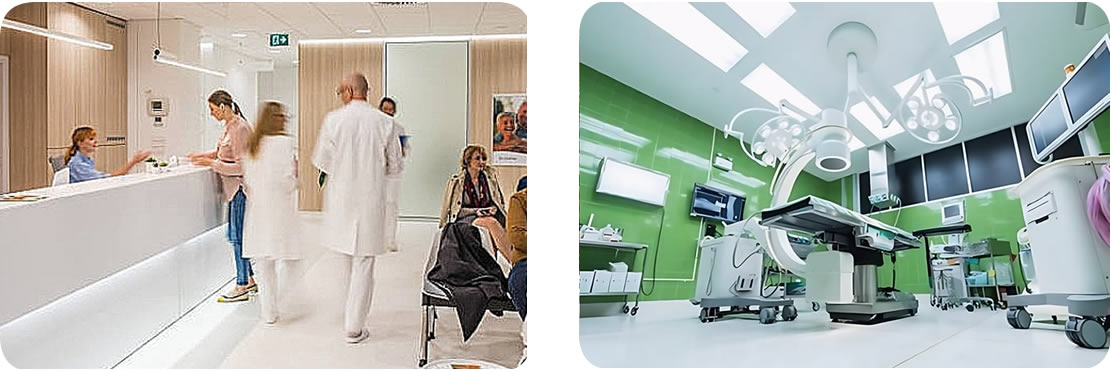
Hospitals, health centers, clinics
Schools, commercial offices, shopping malls, gyms, movie theaters, restaurants
Airports, subways, trains, bus stations
Residences and Hotels
Animal breeding facilities for production
Do you want to implement Far-UVC safely?
Contact us for consulting, specifications, and implementation in accordance with applicable standards.